Showing posts with label Brigade Models. Show all posts

Wednesday, May 1, 2019

Full Thrust: Spacewreck!

An old deleted post from 2013 rescued from the Wayback Machine archives and updated for 2019.
 

One last creation from the bits box, as described over on this post.

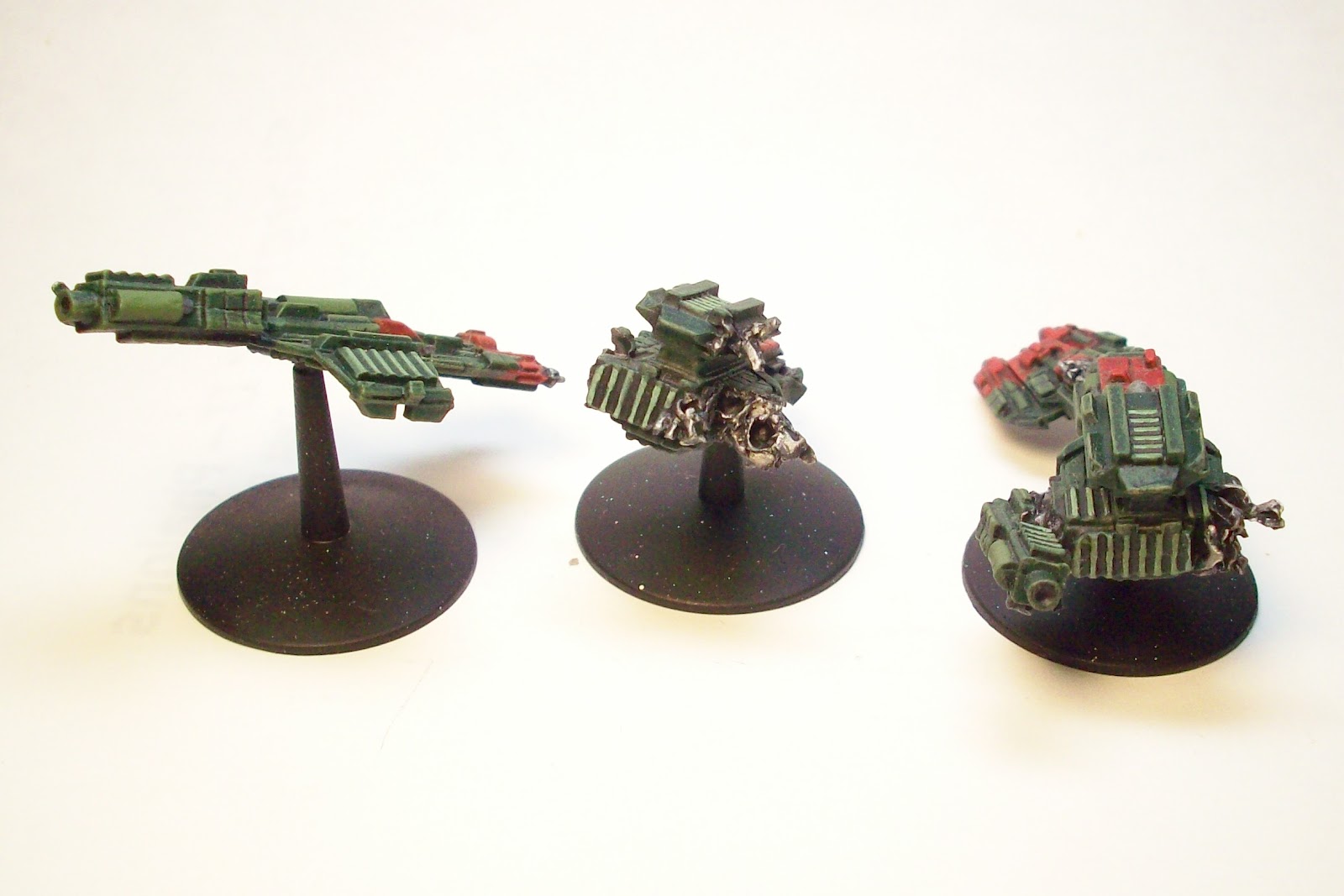
A few of my "lemonade" projects, produced when I had a some defective castings from Ground Zero Games' ESU starship range. I got replacements from GZG promptly, but there was no reason to let some perfectly good potential spacewrecks go to waste.  I applied a little clipper surgery and some paint and presto!  Instant battlefield debris.
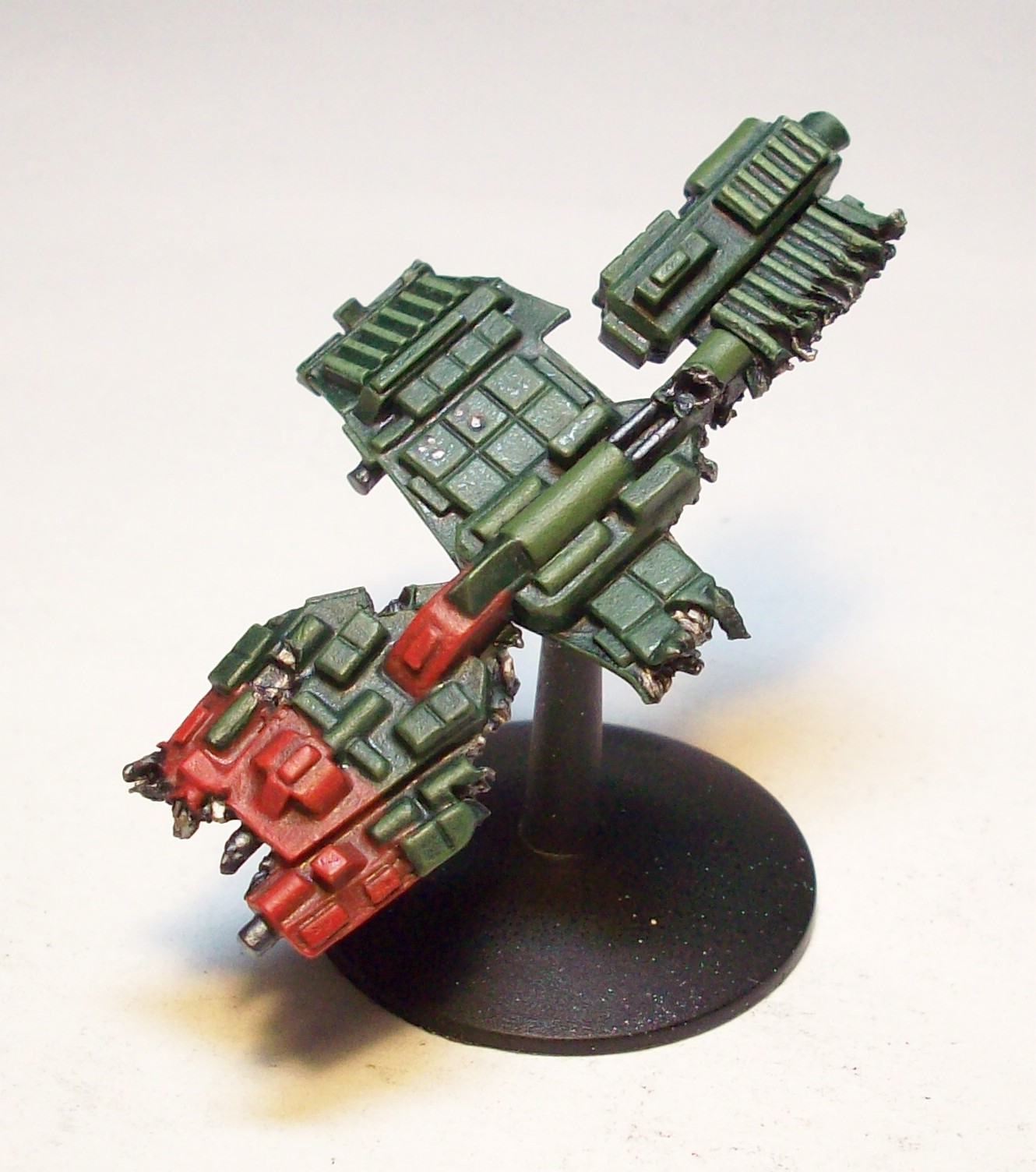

VKK Kasimir Lenov
Built from an ESU heavy cruiser model 
(Left)


Sensor Contact UC-67-717
Built from the aft hull of an ESU battlecruiser (Center)


VKK Yen Wo Long
Built from the aft hull of an ESU battleship, the prow of an escort cruiser, and
an orphaned heavy cruiser engine pod (Right)

Of course there's no sense in having a collection of hulks without a way to use them as something other than simple table dressing. You can obviously make scenarios where recovery, exploration, or destruction of a wreck is a primary objective for one or both sides.  Alternately, you could also give them some simple rules to make them unpredictable "terrain" for a standard fleet battle.  My suggestion for such rules:
 
If all players agree, you can set up 1d3 space wrecks per player (or whatever number best fits your collections) before the game begins.  Their starting positions are determined by holding a d6 about a foot over the center of the table and dropping it, with the wreck being placed where the die lands.  If the die falls off the table completely, re-drop until it doesn't.
 
Space wrecks can be either stationary or drifting.  Either choose (drifting's more fun but more complex) or roll 1d6 for each wreck with evens being stationary, odds being drifting.  Stationary wrecks stay where they're set up all scenario.  Drifting wrecks start the game with a speed of 1d6+2 MU and move directly toward the most distant table edge from their starting point.  Mark the drift vector with an arrow counter, d10, toothpick, or similar pointy directional thing so you remember it's drifting rather than stationary.
 
The first time each game that one or more ships (not other drifting wrecks or terrain features) end movement within 6 MU of a given spacewreck, roll 2d6 and consult the chart below.
 
2-3: BOOM!  Rigged as a deathtrap by its last few doomed crewmen, the ship's power core goes critical when any ship comes into close proximity. The wreck explodes immediately with the same effect as a class 2 plasma bolt. No PDS fire can be used against the blast due to surprise.
 
4-5: Not Quite Dead Yet.  Although long abandoned, the ship's malfunctioning AI has managed some repairs and defends itself with mechanical fervor. The wreck has one Fire Control System, jury-rigged guns equal to three class 1 beams with 360 degree arc of fire, and takes six points of damage to destroy completely (no threshold checks taken from damage). It fires at the closest ship (but not other space wrecks) immediately, and in each later turn at the very start of the ship fire phase.
 
6-8: Just A Hulk.  The wreck is a wreck, and nothing more.  For scenarios where you're trying to recover loot, info, artifacts, or just explore wrecks, this is the result for you.
 
9-10: Thumbing Down A Ride.  A handful of engineers have survived the destruction of the ship and are desperate for a way off the wreck before their jury-rigged life support runs out. The first ship to end its move within 6 MU of this wreck with a velocity of 6 MU or less may pick up the survivors, adding a single damage control team to the last open hull box on its control sheet. If there are already DCTs in every hull box on the ship, the survivors will reluctantly wait for the next bus. 
 
11-12: Input Last Command?  The wreck's AI accepts a last self-destruct command from a nearby ship, exploding in a storm of directed debris. The wreck makes an attack against any one target chosen by the owner of the nearest ship, with effects identical to three submunition packs.
 
Obviously you can alter the chart above to reflect scenario specific situations, such as the wrecks being aligned with one side or another or possibly containing some vital McGuffin that needs to be recovered. For simple free-for-all fights with a wreck or three drifting about the battlespace, they should do as written.
 
Wreck of the PFSS Fitzgerald Edwards
 
 
A rare miscast from Brigade Models' PacFed range, with considerable extra mangling added.  There's something oddly satisfying about drilling holes in a model.
 
Remains of the Arrow of Heaven
 
 
Wreck of a custom built (or maybe unbuilt) IslamaFed battleship using parts from a Ground Zero Games miniature.
 
Remains of the superdreadnought Valiant
 
 
Badly miscast Cold Navy ship converted to a hulk.  A resin model, metal wouldn't have been stable at that angle even with a 1.5" base.
 
Infested hulk of the Warder
 
 
Wrecked escort cruiser being devoured by astrofauna.


Sunday, April 28, 2019

European Federation Variant Fleet Statistics for Full Thrust

 
I've tackled doing Full Thrust stats for Brigade Models' EuroFed range several times now, including these two earlier posts:


While the posts seem to be pretty popular (at least judging by how many hits they've had) there have been a few complaints.

 
Apparently some people flat-out refuse to use salvo missile systems for a variety of reasons.

 
Sometimes the complaint is complexity, sometimes they think the weapons are too strong, and sometimes they think they're too weak.

 
Since I deliberately built the fleet to showcase heavy rack missile armaments, it doesn't work very well as written for these folks.

 
Now, I admit missile racks worry me a bit sometimes as well, and I'm an obliging guy, so here's a proposal to modify the previous statistics so they use fewer salvo missiles, including the option to swap them out entirely.

 
The variant is simple:  Take any salvo missile rack a EuroFed ship mounts and replace it with four submunition packs.  Costs and Mass remain the same.  You can change out some, none or all of the racks as desired.  The resulting ships will still have the same overall tactic of "one big shot and then decide whether to stay and fight or run away" but getting that shot off becomes harder and puts you more at risk.  On the plus side, you can stop caring about point defense and you'll probably appreciate that big Thrust 6 rating even more than you used to. 

 
Submunitions have a single 60 degree arc of fire.  The four packs that replace each missile rack should have the "center" firing arc of the three the rack had.  In most cases this will be the Front arc, although there are exceptions.  The Abruzzi, for ex, would have the "wing" racks centered Front-Starboard or Front-Port. 

 
Some folks use the Continuum rules, which give submunitions 180 firing arcs for no extra cost.  I don't think that's very balanced personally, but if you're doing that you can just use the same firing arcs for both racks and packs here.

 
The background fluff for this swap goes like this:
 
As time went by the EuroFed High Command found their commitment to extensive missile armament increasingly problematic.  Modern NAC and NSL ship designs were employing heavier and heavier fleet defense systems and individual point defense arrays, making it harder and harder to deliver crippling strikes.  Worse, the Xeno War brought EuroFed forces into direct conflict with alien technology that was even more effective at stopping massed missile attacks.  Kra'Vak scatterguns had limited ammunition, but it was generally more than sufficient to pull the teeth of human missile and fighter strikes.

 
In response, Fleet R&D developed the "Carreau" hypervelocity submunition.  These small semi-guided missiles were designed to replace the larger shipkiller warheads used by conventional seeker missiles used by the fleet, with half a dozen submunitions in each missile's alternate payload.  Carreaux were equipped with overpowered ultra-short-ranged "sprint" drives and relied on kinetic impact rather than explosive charges to inflict damage.  The combination of high final approach speed and lack of a warhead to detonate made the submunitions effectively invulnerable to point defense weaponry, although it also reduced range and accuracy to an extreme degree.       

 
So, in this variant, the missile racks are still there, but their payload has been swapped out with shorter ranged submunition-pack carriers that aren't affected by PDS fire due to speed, numbers, and being a solid chunk of metal rather than a shaped-charge penetrator warhead.  If you want to be "realistic" about things you might require all four submunition packs that replace a single salvo rack to fire all at once and at a single target, but that's up to you and might be too limiting.  

Wednesday, April 17, 2019

Full Thrust House Rule: Knocked Off Course


Brigade Pacific Federation
 
Following a recent discussion about Full Thrust being boring and predictable to play (something I don't agree with, incidentally) it seemed like a good idea to re-post an old house rule I've used on and off for years now.  This is the latest iteration of it with some refinements from game play, and it's intended to be a "chaos enhancer" in games by adding another variable to play and breaking up formation maneuvering.  Like all house rules you should get your opponent's approval before playing with it.
 

Cyprian Rift Obsidian Fleet
 
Knocked Off Course:
 
Severe damage will sometimes result in sudden unexpected changes in a ship's course.  This may be the result of sheer kinetic impact, damaged drives flaring and sputtering wildly, an unbalanced spaceframe as parts of the hull are blown off, or the ever popular "dying helmsman falls on his controls" trope.
 
Whenever a ship takes a threshold check, roll one extra die to see if the vessel's course is affected by the damage.  This check uses the same target number as the threshold checks (6 for the first check, 5-6 for the second, etc.) and therefore is more likely to occur as damage mounts.  Modifiers are applied as normal, so for example a ship that goes completely past the first two threshold points in one volley would test on 4-6 (5-6 for the second thresh point +1 for the "skipped" first one).  If the ship is affected it is said to be "Knocked Off Course" and the following procedure is used depending on whether you're using Cinematic or Vector movement rules.
 

Firestorm Armada Directorate
 
Cinematic:  The ship's course changes.  Roll 1d6 and consult the following chart.
 
1:  Change the ship's heading two points (60 degrees) to starboard.
2-3:  Change the ship's heading one point (30 degrees) to starboard.
4-5:  Change the ship's heading one point to port.
6:  Change the ship's heading two points to port.
 

Hand-sculpted By Yours Truly
 
Vector:  The ship's course changes AND the vessel tumbles wildly.  First roll 1d6 and consult the following chart.
 
1-3:  Move the ship's course arrow one point (30 degrees) to starboard.
4-6:  Move the ship's course arrow one point to port.
 
After adjusting the course arrow, roll 1d12 and change the ship's facing to that direction on the clock face (with 12 o'clock being the current facing).
 

Full Thrust Phalon
 
If you don't have a d12 (seriously? are you sure you're a gamer?) roll a 1d6 followed by a second 1d6.  If the second roll is 1-3 add nothing to the first roll.  If the second roll is 4-6 add 6 to the first roll.  Treat the result as the d12 roll above.
 
Did I really need to tell anyone how to do that?
 

Studio Bergstrom Auran Dominate
 
Any changes to heading and/or facing occur immediately, which may affect firing arcs if the ship hasn't fired yet this turn.  A particularly unlucky ship might take several volleys causing threshold checks during a turn and possibly be knocked off course multiple times, with each incidence resolving independently.
 

Full Thrust NAC, new and old
 

Tuesday, March 19, 2019

Full Thrust Convoy TQX-5551: Outbound for the Frontier at last

After a week of showcasing the ships in this convoy in smaller lots, we've finally got some big full-group shots.
 
 
Total of 30 ships plus a pair of small cutters which can be seen docked to two of the ships as well as being their own seperate models.

 
Fourteen civilian ships in a bunch of different styles, fourteen escort warships of varying sizes, a big UNSC science ship that kind of straddles the line between civilian and military, and a huge auxiliary warship built off a converted military fleet tender.
 
Most models are from Ground Zero Games' Full Thrust range, with a few Brigade Models and Silent Death minis mixed in.  Includes the following:
 
2 NAC Troutbridge frigates (GZG)
1 NAC Fort Carstairs auxiliary warship (converted GZG fleet tender)
2 New Israeli Tzayad destroyers (GZG)
2 ScanFed Hrafn frigates (GZG)
2 Free Cal-Tex Austin destroyers (GZG)
1 Japanese Soyokaze destroyer (GZG)
2 Japanese Ashigaru frigates (GZG)
1 Japanese Shoya sensor picket (GZG)
1 UNSC Mountain light cruiser (GZG)
2 UNSC Lake destroyer (GZG)
1 UNSC Deep Space Explorer (converted GZG Visionary explorer)
5 Tradewind and Tradewind 2 cargo ships (GZG, one of each variant)
1 Olympus passenger ship (GZG)
1 Kestrel free trader (GZG)
2 Luxury space yachts (GZG, one lightly converted)
1 Merino livestock transport (GZG)
1 Aquarius liquid transport (Brigade)
1 Solar Mariner far trader (Brigade)
1 Sentry guardship (Silent Death)
2 little cutters on separate flight bases (GZG 15mm Stargrunt figs) 

 
You can see more photos and a bunch of background stuff at the links below:


Saturday, March 16, 2019

Full Thrust Free Traders & Convoy Escorts

Looks like the rest of the convoy's finally arrived.  First up we've got a selection of civilian ships from Ground Zero Games and Brigade Models. 
 
 
Not all merchantmen are part of a larger corporate fleet, and there are many self-described "free traders" travelling the stars.

 
Too small to compete with the megacorporations of the Core Worlds, these entrepreneurs mostly ply their trade in the Outrim frontiers, an area of space that's become increasingly dangerous since the Xeno Wars began.

 
Even the most independent captains have been driven to joining up with convoys for safety in these troubling times, breaking off only for the final leg of their journey to whatever obscure colony world their route ends at.

 
These convoys are invariably escorted by ad-hoc mixes of small military ships from various navies. 

 
Seen here we have a pair of Free Cal-Tex Austin-class destroyers (front row left), two New Israeli Tzayad-class destroyers (front row right), a Japan Incorporated force composed of two Ashigaru-class patrol frigates and a Shoya-class sensor picket (center row), and two ScanFed Hrafn-class frigates..

 
Convoy escorts are generally fast, maneuverable ships with moderate armament rather than heavier fleet elements that would be more useful in front-line battlegroups.

 
Although better trained and more disciplined than any pirate group, multi-national convoys like this one often suffer from conflicting goals priorities which can leave them at a disadvantage against raiders from a proper military organization.
 
 
For this reason it's common to see a contingent of UNSC vessels placed in overall command of the convoy, as they're seen to be non-partisan by most parties.


Friday, March 8, 2019

"White Knights" - Stargrunt ORCDeF Grav-Mobile Space Marine Infantry Platoon

Latest project off the workbench, a platoon of Ground Zero Games' OutRim Coalition Defense Forces naval marines with a trio of Brigade Models' Lynx grav IFVs for transport and fire support.
 
 
Three squads of eight soldiers, each squad having a light SAW, a leader figure, and several rifle troopers.  The first squad also includes a smart missile launcher and a specialist with a heavy anti-material rifle for pinpoint sniping work.


The second and third squads are similar but replace the weapon specialists with direct fire fusion guns for short range anti-armor work and breaching duties.  The DFFGs are also quite good at starting fires, making the sealed, armored,  heat-resistant environmental suits of the marines something of a necessity.


Most marine E-suits are also equipped with a "smart camo" system that allows them to change their coloration from the default off-white with a simple menu selection using their onboard electronics and quick splash of a specialized chemical solution that starts the color shift.  Use of this system is often skipped on by the marines whose reputation on the Frontiers is such that just seeing a unit of the "White Knights" attacking is sometimes enough to break their foes.  


I resisted the temptation to leave all their gear and weapons flat black so they'd look even more like Star Wars stormtroopers, but let me tell you, it wasn't easy.